
- Home
- wine blog
- types of wine
- 20 + Types of White Wine Everyone Should Know


Chardonnay
Born in France and now vinified the world over, Chardonnay is America’s most-loved white wine types, and is a favorite grape of winemakers because of its incredible versatility. Made from green-skinned grapes of the same name, Chardonnay wines can run the stylistic gamut, from light and crisp, to medium bodied and fruity, to full, voluptuous and heavily influenced by oak—they can even be still or sparkling. (Many bottles of Champagne and white Burgundy, two of the world's most celebrated wines, are made with Chardonnay.) Chardonnay can also express a variety of flavors, including orchard fruit, tropical fruit and citrus notes, as well as subtle chalky, salty or mineral tones, and oak-driven characteristics like vanilla, butter, caramel and cinnamon. All these possibilities mean there’s a type of Chardonnay for everyone.
Style: Light – Full
Common Flavors: Apple, pear, pineapple, papaya, lemon, grapefruit, chalk, flint, vanilla, butter, caramel, brioche, toast, biscuit
Prominent Regions: France, California, Washington, Oregon, Australia, Italy
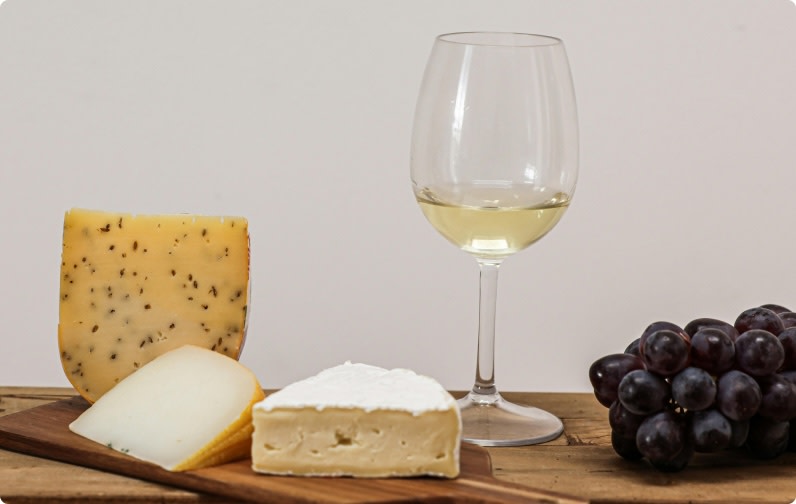
Food Pairing: Chicken, seafood, butter/cream sauces, risotto, soft cheeses
Sweetness: Dry
Riesling
Riesling—made from white-green-colored grapes of the same name—is one of the world’s most fascinating and most delicious types of white wine. Many people think all Riesling is sweet, but that couldn’t be further from the truth. Because its grapes retain acidity well, ripen late in the growing season and have relatively high tolerance to frost conditions, Riesling can be produced all over the world and crafted in a bewildering amount of styles. It can be super dry and mineral-driven, with electric-like acidity; light and crisp with balanced fruit flavors; medium weight and tropical; luscious and very sweet; and more. When it comes to Riesling wine, the only thing that is for sure is that it will be incredibly food friendly, thanks to its medium to high acidity.
Style: Light – Medium
Common Flavors: Lemon, grapefruit, lime, white peach, nectarine, pineapple, beeswax, petrol, minerality, honey, candied ginger
Prominent Regions: Germany, New York, France, Austria, New Zealand, Australia, Italy
Food Pairing: Asian food, spicy dishes, duck, ham, sausages, pork, shellfish, vegetarian, soft cheeses
Sweetness: Dry – Very Sweet
Chenin Blanc
Like Riesling, Chenin Blanc—or just Chenin, for short—is a bit of a chameleon, with a high acidity that allows it to be crafted in an array of dry and sweet styles. Produced from green-skinned grapes of the same name, it has been made in its native France for around 1,300 years, and has since found a second home for itself in South Africa, where it’s sometimes called Steen. (Though, fun fact: For a brief time, pre-1980, California cultivated the most Chenin vines worldwide.) Arguably, the most beloved examples hail from France’s Loire Valley, where minerality, floral notes and orchard fruit flavors reign supreme, and exceptional sweet styles emerge from the area of Vouvray. No matter where it’s made, Chenin Blanc is known for its incredible longevity, able to age gracefully for several decades.
Style: Light – Full
Common Flavors: Minerality, apple, quince, pear, honeysuckle, beeswax, lanolin, honey
Prominent Regions: France, South Africa, California, Australia, Argentina
Food Pairing: Asian cuisine (esp. Chinese), chicken, seafood (esp. with lemon), fried foods, vegetables
Sweetness: Dry – Sweet
Gewürztraminer
Pronounced “gev-OORTZ-tra-meener,” Gewürztraminer is a highly aromatic, zesty white wine made from curiously pink-skinned grapes of the same difficult-to-say name. Made primarily in Alsace, France and throughout Germany, Gewürztraminer also does well in the Alto-Adige region of Italy and neighboring Austria, and is cultivated in pockets of New York, Australia and New Zealand. Its ginger and lemongrass-like spice is undeniably its trademark, usually accompanied by aromas and flavors of lychee and stone fruit. Otherwise, however, this type of white wine has near bottomless stylistic possibilities—it can be light and bright, medium-weight or rather full and plump on the palate, and can range from bone dry to pretty darn sweet—but will always be immensely driven by terroir. It’s also almost-always a great value, with excellent bottles available for much less than Chardonnay or Riesling of similar caliber.
Style: Light – Full
Common Flavors: Lemongrass, ginger, lychee, white peach, apricot, nectarine, tangerine, flint, smoke
Prominent Regions: France, Germany, Austria, Italy, Australia, New Zealand, New York
Food Pairing: Asian cuisines, Mediterranean vegetables, chicken, pork, duck
Sweetness: Dry – Sweet
Moscato
Moscato wine is made from a specific type of white Muscat grapes called Muscat Blanc à Petits Grains. It can be crafted in still, sparkling and dessert styles, however, most examples are generally light bodied, low in alcohol and quite sweet. This is because the technique used to produce it involves chilling the wine during the fermentation process that turns regular grape juice into an alcoholic beverage. This stops everything cold (literally) before the juice’s natural sugars can be converted into alcohol, leaving an abundance of sugar in the final wine and resulting in a 5–9% alcohol by volume (ABV). Many versions are also slightly fizzy or full-on sparkling, like the celebrated Moscato d’Asti from Piedmont, Italy. And all versions will be highly aromatic, with citrus, stone fruit and floral aromas.
Style: Light
Common Flavors: Pink grapefruit, white peach, white nectarine, orange blossom, honeysuckle
Prominent Regions: Italy, California, Spain, South Africa
Food Pairing: Turkey, pork, eggplant, hearty salads, tangy cheese, seafood
Sweetness: Semi Sweet – Very Sweet
Sémillon
Beloved for both its dry and sweet expressions, Sémillon (also seen as Semillon, without an accent) is a white wine made from gold-skinned grapes of the same name. Arguably, the most famous of its wines come from France, where it plays a major role in the production of White Bordeaux and a very sweet, very celebrated dessert wine called Sauternes. The latter is made with grapes that’ve been affected by Botrytis cinerea, a type of benevolent fungus. In both cases, Sémillon grapes may be blended with Sauvignon Blanc and Muscadelle to yield delicious results. Sémillon wine also shines when produced in Australia’s Hunter Valley, where it’s crafted in vibrant, high acid styles, and across the continent in the Margaret River area, where, as in France, it’s blended with Sauvignon Blanc. Curiously, it was once the most-planted white grape in South Africa and Chile, but has fallen out of favor in recent years.
Style: Medium – Full
Common Flavors: Lemon, lime, apricot, peach, nectarine, mango, toasted nuts, honey
Prominent Regions: France, Australia, South Africa
Food Pairing: Shellfish, chicken, pork, herb sauces, zesty green salads and other vegetarian dishes, goat cheese
Sweetness: Dry – Very Sweet
Roussanne
Named for the French word roux (“reddish-brown”) because of the golden-brown color its grapes turn when ripe, Roussanne is one of the two most important white wine types of France’s Rhône Valley and one of just a handful of whites allowed in Châteauneuf-du-Pape. Though often blended with Marsanne, varietal expressions do exist and are definitely worth seeking out! Vibrant and textural, they are known to present an array of pear and stone fruit flavors, plus floral tones of honeysuckle and chamomile, with honey, nutty and/or tea-like nuances. What’s more, they are medium to full bodied, with medium to high acid and medium to high intensity—an ideal combination for long-term cellaring.
Style: Medium – Full
Common Flavors: Pear, white peach, apricot, honeysuckle, chamomile, toasted nuts, honey, herbal tea
Prominent Regions: France, California, Texas, Australia
Food Pairing: Turkey, chicken, white pastas, salads, soft cheese, fish
Sweetness: Dry
Macabeo
Also known as Viura in the Spanish regions of Rioja and Navarra, Macabeo is a white wine made from grapes of the same name(s). The grape is cultivated on both the French and Spanish side of the Pyrenees mountains, however, the overwhelming majority of vines grow throughout Spain. There, winemakers basically have their pick of production techniques, thanks to the variety’s great versatility: Macabeo wines can be fresh and floral when aged in stainless steel, voluminous and nutty on the palate when aged in oak, or even smooth and honey-like when its grapes are harvested slightly later. They can be dry, sweet, still or sparkling, and can be incorporated easily into blends of any kind. To that end, Macabeo is a key component of Cava, Spain’s principal sparkler, for which it’s often blended with Parellada and Xarel-lo.
Style: Light – Medium
Common Flavors: Peach, apricot, lemon, yellow apple, honeysuckle, toasted nuts
Prominent Regions: Spain, France
Food Pairing: Chicken, turkey, pork, fresh shellfish (and white fish), vegetable dishes, light salads
Sweetness: Dry
Aligoté
Known as the “other white Burgundy,” Aligoté is a charming white wine made from grapes of the same name and has been produced alongside Burgundian Chardonnay for over two centuries. Though the two grapes are genetically related, Aligoté has never been able to achieve the same celebratory status as Chardonnay. As such, its grapes have been historically relegated to inferior vineyard sites and its bottlings have not been particularly promoted. Today, that’s a great thing for wine lovers, as it means prices are comparatively low for top-quality expressions. That said, the two wines are not identical. Typically medium bodied, Aligoté has similar lemon and orchard fruit qualities, but is much more mineral-driven, with wet stone, flint or salinity often leading their flavor profile.
Style: Medium
Common Flavors: Minerality, flint, lemon, pear, white peach, acacia, honeysuckle
Prominent Regions: France
Food Pairing: Shellfish (esp. oysters or clams), fish (esp. haddock or cod), charcuterie, fresh vegetables (crudités), creamy cheeses
Sweetness: Dry

Verdicchio
Produced almost entirely in Italy, Verdicchio is a crisp, easy-drinking white wine made from green-skinned grapes of the same name. Everything about Verdicchio is rather pleasant: The wine is extremely versatile on the table and refreshing to drink on its own, and its grapes adapt well to a variety of soils and climates, and are easy enough to handle in the winery. Italy’s Marche region has two Denominazione di Origine Controllata (DOC)—classified areas specifically dedicated to the production of Verdicchio wines: Verdicchio dei Castelli di Jesi and Verdicchio di Matelica. Though everyday table wines are made there, the two DOCs also yield complex, textural and age-worthy examples with more vibrant fruit flavors and a persistent almond-like undertone.
Style: Light – Medium
Common Flavors: Lemon, lime, white grapefruit, green apple, pear, almonds, pine
Prominent Regions: Italy
Food Pairing: Antipasti, simply prepared white fish (esp. sea bass or sole), fried seafood (calamari, shrimp), risotto, soft cheeses like mozzarella di bufala
Sweetness: Dry
Uncork More
There’s a whole world of white wine and wine grapes out there to discover—these are just a handful of the most popular white wine types and styles. Now that you have a bit of know-how, it’s time to start tasting some bottles. Explore our entire selection of white wines and be sure to reach out to a Personal Wine Advisor if you have any questions.

AUTHOR
CANDICE, PERSONAL WINE ADVISOR
I have over 10 years of experience in the wine and beverage industry, and have tasted some of the rarest and most sought-after wines. I'm your ideal oenophile today—pour me a Cru Beaujolais.
- WSET – Level 2 Wines & Spirits Certified
- CMS – Level 1 Sommelier Certificate
Favorite Wine: Barolo • Natural Wine • Austria/Germany • Island Wines
candice@wsjwine.com | (203) 523-2164