


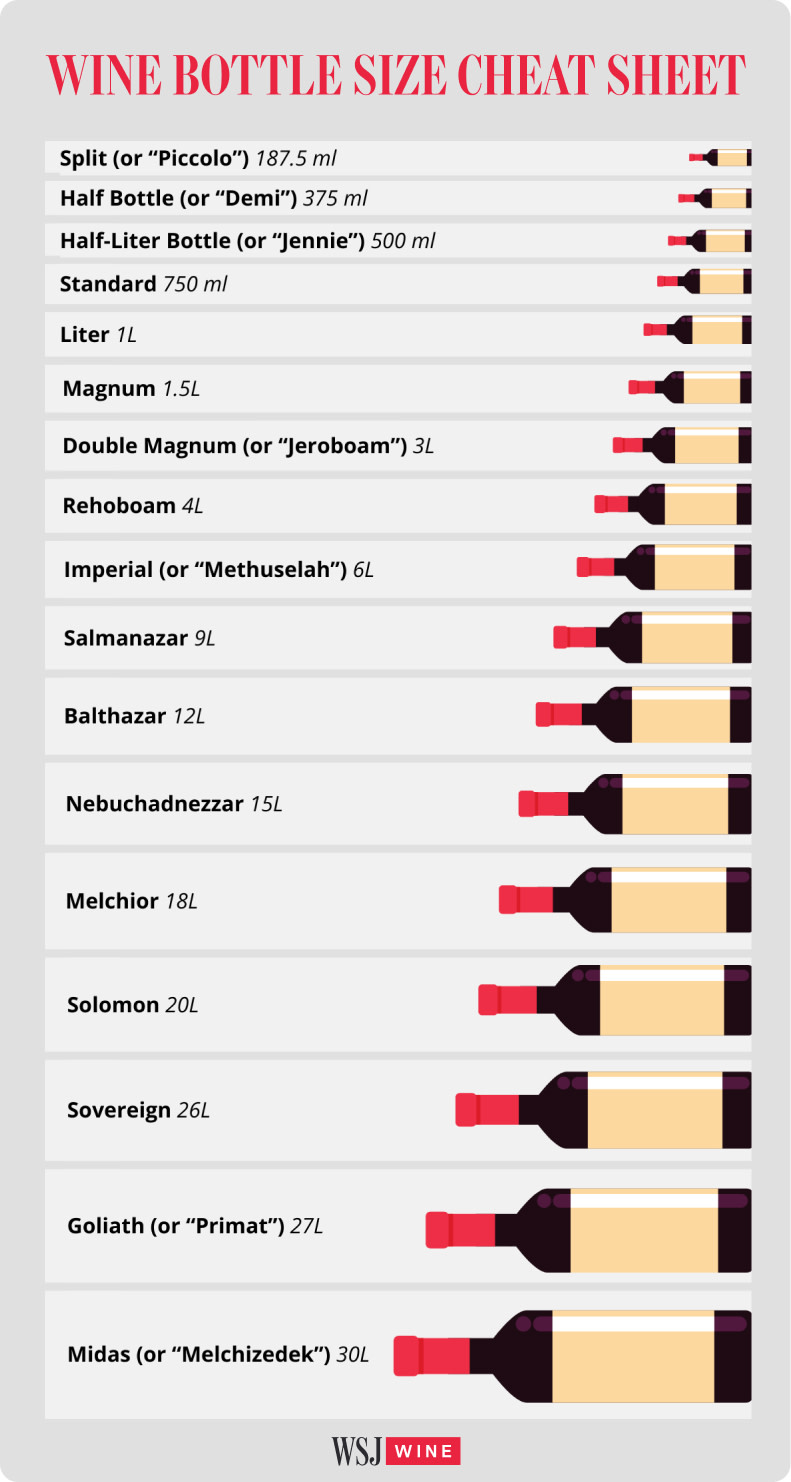
- Split (or “Piccolo”) 187.5 ml
This mini-bottle size holds enough for one glass of wine. - Half Bottle (or “Demi”) 375 ml
This small bottle is half the size of the standard bottle of wine. Providing about three glasses of wine, it’s perfect for a dinner for two. - Half-Liter Bottle (or “Jennie”) 500 ml
This small bottle is half the size of the rarer 1-liter format. It’s common for sweet wines, which are typically poured in smaller amounts and last longer than dry wines. - Standard 750 ml
As the name suggests, this is the most common bottle size and comes in many different shapes (broad-shouldered Bordeaux bottles, squat Burgundy bottles, etc.). It holds six glasses of wine, perfect for parties of two to four. - Liter 1 liter
The name might be obvious, but it’s quite rare in the U.S. The bottle gives you eight glasses of wine and is a great choice for a small dinner party (three to five people). - Magnum 1.5 liters
This big bottle is twice the size of the standard 750 ml bottle. Holding 12 glasses of wine, the big bottle allows everyone at the table to have a glass of the same wine. A favorite selection for dinner parties with five to eight people. - Double Magnum (or “Jeroboam”) 3 liters
Now, things are getting serious. This heavy, outsized bottle is four standard bottles in one. Pouring 24 glasses of wine, the Jeroboam (pronounced “jehr-uh-bow-uhm”) is an impressive centerpiece for a party or holiday dinner (10 to 15 people). - Rehoboam 4 liters
This format holds an impressive 32 glasses of wine. Reserve this one for large gatherings (20 to 25 people). - Imperial (or “Methuselah”) 6 liters
As the name suggests, this bottle size is fit for a royal gathering, holding the same amount as eight standard bottles and 48 glasses of wine. - Salmanazar 9 liters
Named after a king in the Bible (and pronounced “sal-muh-nayz-er”), this massive bottle is 12 standard bottles in one, providing 72 glasses of wine. - Balthazar 12 liters
Another biblical king, Balthazar (pronounced “bal-thuh-zar”) is 16 standard bottles in one. That gives you 96 glasses of wine for a very special, very big gathering. - Nebuchadnezzar 15 liters
The third in this series of biblical kings, the Nebuchadnezzar (pronounced “neh-buh-kuhd-neh-zer”) holds the same amount as 20 standard bottles. Providing 120 glasses of wine, it’s a show-stopping bottle for a significant event. - Melchior 18 liters
The fourth in the series of biblical kings, a bottle of Melchior (pronounced “Mel-kee-or”) is 24 standard bottles in one, holding 144 glasses of wine. - Solomon 20 liters
The fifth (and final) biblical king of the bottle formats, the Solomon provides about 160 glasses of wine. - Sovereign 26 liters
This kingly size holds about 208 glasses of wine! - Goliath (or “Primat”) 27 liters
A giant of giants, a Goliath is the same amount as 36 standard bottles, holding 216 glasses of wine. - Midas (or “Melchizedek”) 30 liters
The king, this supremely larger-than-life bottle is 40 standard bottles in one. That’s 240 glasses of wine!

AUTHOR
REANNA , WINE ADVISOR TEAM DIRECTOR
Originally from England, yet born in India, now living in the States, I have had a rather colorful life—with most of it being in all the shades, pigments, perfumes & plethoras of wonderful wine.
- WSET – Level 3 Wines & Spirits Certified
- Sake Level 1 Certified
Favorite Wine: Oaked Sauvignon Blanc • Aged Sémillon • Spicy Shiraz/Syrah • Tuesday night Etna Rosso • Vintage Champagne!
reanna@wsjwine.com | (203) 523-2159