
- Home
- wine blog
- types of wine
- Champagne vs. Prosecco


All Champagne is From France
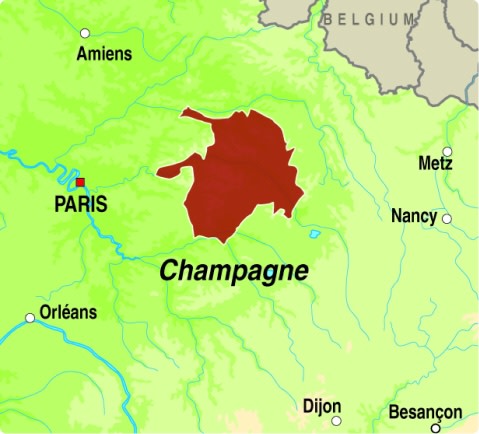
For a sparkling wine to be labeled as Champagne, it must be produced in the Champagne region of France. In the northeastern part of the country, about an hour’s drive east from Paris, this is the only place in the world where Champagne can be made. The name “Champagne” has been protected under European law since the mid 1800s, with its production zone first delineated in 1927 and established as an official Appellation d'Origine Contrôlée (AOC) in 1936.
The region spans approximately 84,000 acres across 319 municipalities (known as crus), which are divided into five departments, the Marne, Aube, Aisne, Haute-Marne and Seine-et-Marne. These crus are further split into four main subregions called Montagne de Reims, Vallée de la Marne, Côte des Blancs and Côte des Bar.
But these geographical boundaries are not the only confines by which Champagne makers are bound. As part of an AOC, winemakers must follow strict rules to ensure their sparkling wine is authentic Champagne. In the vineyard, for instance, only approved pruning methods are allowed, and only a certain amount of grapes can be harvested. And, crucially, only a certain set of grape varieties can be used to produce it.
Grapes for Champagne
Champagne can be made from a single variety or a blend of grapes, however, there are only seven grapes used for production. Two of these, Pinot Noir and Pinot Meunier, are red, and they are the most commonly used varieties, along with Chardonnay, a white grape. Pinot Blanc, Pinot Gris (known locally as Fromenteau), Petit Meslier and Arbane are the other wine grapes used for Champagne. Historically more common, these are now only used in small quantities. Champagne made from all white grapes is known as Blanc de Blancs. Champagne made from just red grapes is known as Blanc de Noir.
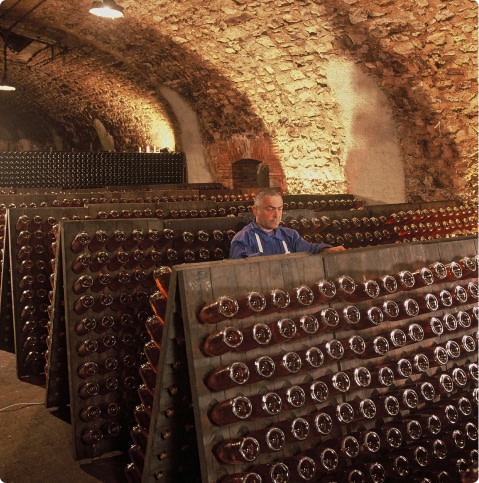
The process starts the same way any still white wine would be created: Grapes are harvested and pressed off the skins to extract juice, and the juice is fermented. Once fermentation is complete, the base wine is blended—with portions of wine from other grape varieties or vineyard sites, and/or with reserves of wine saved from earlier vintages—a step known in Champagne as assemblage.
To give Champagne its sparkle, the blend must next undergo a second fermentation (or prise de mousse) in bottle. It’s moved into extra-thick glass bottles designed specifically to withstand a buildup of pressure, along with a solution called liqueur de tirage, made of wine, yeast and sugar.
Everything gets sealed tightly with a crown cap and is left to rest in a cool cellar. In time, the yeast consumes the sugar and converts it into alcohol and carbon dioxide (CO₂). Because the bottle is sealed securely, that CO₂ has nowhere to go, and it dissolves within the wine to form the bubbles we all know and love.
As fermentation proceeds, the yeast cells will die and collect at the bottom of the bottle. This sediment, called lees, imparts toasty flavors of pastry and biscuit (more on that later). By law, all non-vintage Champagne must stay in the cellar, resting on that lees, for at least one year, while all vintage Champagne requires a minimum of three years.
After this period (or longer, if the winemaker desires), the lees is removed via a process called riddling (remuage in French), in which bottles are turned upside down and placed at an angle. Each day, they are rotated to encourage the lees to slide down into the neck of the bottle.
Eventually, the neck is chilled in a special ice bath, creating a frozen plug around the dead yeast cells. Bottles are opened quickly, and the built-up CO₂ forces the plug out—a process called disgorgement (or dégorgement). Some wine is unavoidably expelled at this time, so bottles are topped up with either more wine or a liquid solution of wine and sugar. The amount of sugar, called dosage, will influence the finished wine’s sweetness level (more on this later, too).
At long last, the Champagne is corked and secured with a wire cage, then returned to the cellar to be aged several months or years further.
Grapes for Prosecco
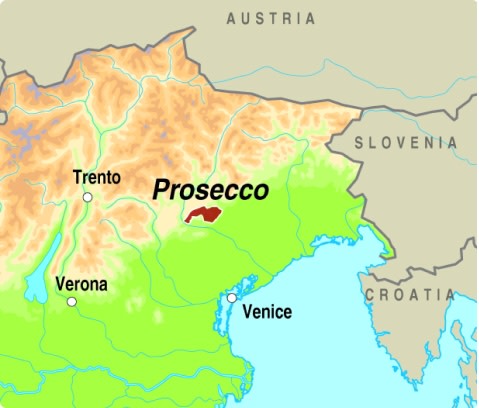
Just as Champagne must adhere to stringent rules as an AOC, all Prosecco is subject to strict regulations to maintain DOC status (and even stricter ones for those bottles with a DOCG classification). Chief among these directives is the grapes allowed for production.
All Prosecco must be made primarily from Glera, a catch-all name for several incredibly genetically similar, highly productive white varieties. While many (if not most) commercially available bottlings are made entirely from Glera, Prosecco can also contain up to 15% Chardonnay, Pinot Bianco, Pinot Grigio and red Pinot Nero (used primarily for Prosecco Rosé), plus local varieties Bianchetta Trevigiana and Perera.
How prosecco Is made
Unlike Champagne, all Prosecco is produced via the much less time-intensive Charmat method, also known as the tank method or Martinotti method.
The process begins in a similar fashion, with freshly harvested grapes pressed off their skins, and their juice fermented into a still base wine. But then, rather than being bottled, the wine is racked (separated from any lees left from its primary fermentation), filtered and transferred to a special, pressurized steel tank called an autoclave.
It’s here that Prosecco gets its sparkle: Liqueur de tirage is added, everything is sealed securely, and as the yeast consumes the sugars, the CO₂ dissolves within the wine to form bubbles.

What Does Champagne Taste Like?
Though wines can differ depending which grapes were used to produce them and how long they were aged, most Champagnes are bright and very bubbly, with high levels of refreshing acidity. They can present a range of fruit flavors—including orchard fruits, citrus and sometimes even red berries—as well as mineral tones and floral qualities.
And don’t forget that lees contact we talked about earlier: As the yeast dies and becomes lees, certain amino acids and proteins are released. This process, called autolysis, creates additional flavors of pastry, bread dough, biscuit, toast and brioche, and lends a creamy, rich mouthfeel to the finished Champagne. The longer a Champagne has stayed in contact with its lees, the more prominent these flavors will be. Extended aging can also intensify these flavors, as well as impart nutty characteristics.
What Does Prosecco Taste Like?
While also refreshing, Prosecco can have more moderate acidity levels and typically does not have autolytic qualities, because its contact with lees is minimal. On the palate, it tends to be a bit lighter and much fruitier, with similar orchard fruit and citrus flavors, and mineral and floral nuances playing a more minor role.
It’s also a bit less bubbly than Champagne. Prosecco generally has 1–4 bars of pressure, while Champagne has 6–7. (To put that into perspective, a can of Pepsi clocks in at 3–4 bars of pressure.) And it’s typically a little sweeter than Champagne, too.
Prosecco’s fermentation, on the other hand, is more controllable because it takes place in large tanks. So once the wine has fermented its minimum required time, the winemaker can choose to end the process by cooling the vessel before the wine has reached total dryness. This would leave some residual sugar that can later be increased with added dosage.
The ratio of sweetener-to-wine in a dosage mixture varies by producer, appellation rules and desired outcome. An ultra-concentrated solution, it can contain up to 500–700 grams of sugar per liter (g/L), but since this is divided between hundreds or thousands of bottles, only about a teaspoon will ever end up in the finished product. The labels of Champagne and Prosecco will usually indicate their sweetness level.
Given Prosecco-makers don’t lose any wine from disgorgement, there’s no need for them to top up bottles or add dosage unless they want to. Champagne-makers may also choose not to add dosage when topping up bottles. These sparklers may be labeled as zero dosage, dosage zéro, brut sauvage, brut nature or pas dosé, and can contain up to 3 g/L residual sugar.
Sparklers labeled as extra brut contain less than 6 g/L residual sugar, an amount still barely detectable by the human palate. Those labeled as brut must have less than 12 g/L residual sugar, but because this category can contain wines with any level of sweetness up to 12 g/L, brut sparkling wines can vary significantly in style.
Extra dry wines contain 12–17 g/L residual sugar and sec wines contain 17–31 g/L residual sugar, which is noticeably sweeter. Demi sec wines have 32–50 g/L residual sugar, a level of sweetness that can feel weighty on the palate. And doux wines are the sweetest of all, with more than 50 g/L residual sugar, and are typically served with or as dessert.


AUTHOR
REANNA , WINE ADVISOR TEAM DIRECTOR
Originally from England, yet born in India, now living in the States, I have had a rather colorful life—with most of it being in all the shades, pigments, perfumes & plethoras of wonderful wine.
- WSET – Level 3 Wines & Spirits Certified
- Sake Level 1 Certified
Favorite Wine: Oaked Sauvignon Blanc • Aged Sémillon • Spicy Shiraz/Syrah • Tuesday night Etna Rosso • Vintage Champagne!
reanna@wsjwine.com | (203) 523-2159